What Is A Solid State Battery?
(2026 Edition)
Quick Answer
A solid-state battery is a battery that replaces the liquid or gel electrolyte used in conventional lithium-ion batteries with a solid electrolyte.
This design can improve safety by reducing fire risk, increase energy density, and enable wider operating temperature ranges.
Solid-state batteries are still in development, with key challenges including material stability, manufacturing scalability, and cost.
Introduction of Solid State Battery
The history of solid-state batteries dates back to the 1950s, when solid electrolytes were first studied for use in thin-film and specialty power sources, long before modern lithium-ion batteries. Research accelerated in the 1990s–2000s as scientists explored solid lithium conductors to overcome safety and energy density limits of liquid electrolytes.
Solid-state batteries matter because they offer the potential for higher energy density, improved safety, and longer cycle life compared with conventional lithium-ion batteries.
What makes a battery a solid-state battery?
A battery is considered a solid-state battery when it uses a solid electrolyte instead of a liquid or gel electrolyte to transport ions between the electrodes.
The solid electrolyte can be ceramic, polymer, or a composite material, and it fundamentally changes how ions move and how the battery is packaged.
This structural difference is what distinguishes solid-state batteries from conventional lithium-ion batteries, not the electrode chemistry alone.
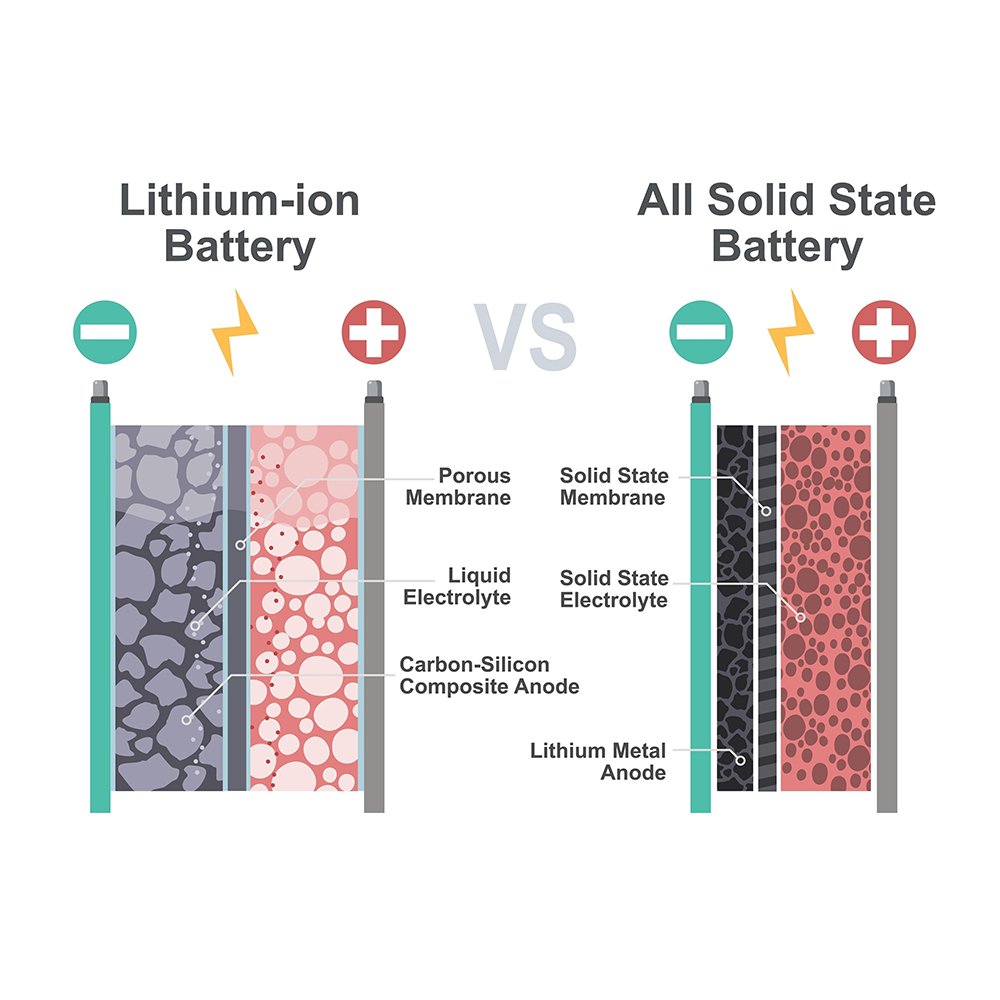
The Anatomy: Liquid vs Solid
How traditional batteries work?
Traditional batteries work by moving ions from the anode to the cathode through a liquid electrolyte during discharge, while electrons flow through an external circuit to provide power.
A porous separator sits between the anode and cathode to prevent short circuits while allowing ions to pass through the liquid electrolyte.
This combination of anode, cathode, separator, and liquid electrolyte defines how conventional lithium-ion and other rechargeable batteries operate.
The Solid Revolution:
Replacing the flammable liquid with a solid-state separator.
The battery solid state replaces the flammable liquid electrolyte and polymer separator used in traditional batteries with a solid-state electrolyte that acts as both ion conductor and separator.
By eliminating liquid components, this solid-state separator significantly reduces leakage and thermal runaway risks.
This shift is a key reason solid-state battery technology is viewed as a major step toward safer, higher-energy rechargeable batteries.
The Anode Evolution: Moving from Graphite to Lithium Metal anodes
In solid-state batteries, the anode can shift from graphite to lithium metal because the solid electrolyte can better suppress dendrite growth than liquid electrolytes.
Lithium metal anodes have a much higher theoretical capacity than graphite, which is why they are central to major energy density improvements.
However, achieving stable lithium metal cycling remains a key technical challenge in battery solid state development.
Advantage & Disadvantage
What are the advantages of solid-state batteries?
Solid state lithium ion battery offer improved safety because solid electrolytes are non-flammable and reduce the risk of leakage and thermal runaway.
They can achieve higher energy density by enabling lithium metal anodes and more compact cell designs.
Solid state lithium ion battery may also provide longer cycle life and better performance across a wider temperature range compared with conventional lithium-ion batteries.
What are the disadvantages of solid-state batteries?
The main downside of lithium ion battery solid state is that they are difficult and expensive to manufacture at scale due to complex materials and strict interface requirements.
Many solid electrolytes suffer from limited ionic conductivity at room temperature or poor long-term stability with lithium metal.
These technical and cost challenges are the primary reasons lithium ion battery solid state are not yet widely commercialized.
Solid State Battery VS Lithium Ion
How does the extreme cold affect solid-state batteries compared to lithium-ion?
Solid-state batteries can significantly outperform conventional liquid-electrolyte lithium-ion batteries in extreme cold because they do not rely on liquids that thicken or partially freeze at low temperatures.
Advanced solid-state systems can retain around 70–75% capacity at −30 °C, while many lithium-ion batteries lose 50% or more due to increased internal resistance and sluggish ion transport.
By avoiding liquid electrolyte viscosity rise and lithium plating risks, solid-state batteries show more stable low-temperature performance.
Do solid-state batteries charge faster?
Solid-state batteries can potentially charge faster than lithium-ion batteries because some solid electrolytes allow high ionic conductivity and better tolerance to high charging currents.
However, many current solid-state prototypes are limited by interface resistance and heat management during fast charging.
As a result, lithium-ion batteries still deliver more reliable fast-charging performance in most commercial products today.
Do solid-state batteries degrade less?
Solid-state batteries can degrade less than lithium-ion batteries because solid electrolytes reduce electrolyte decomposition and unwanted side reactions. At present degradation is still influenced by interface stability, mechanical stress, and lithium metal behavior. Lithium-ion batteries have more well-understood and predictable degradation characteristics
Will solid-state batteries overheat?
solid state lithium batteries are generally less prone to overheating than lithium-ion batteries because solid electrolytes are non-flammable and more thermally stable.
The absence of liquid electrolyte reduces heat generation from leakage and exothermic reactions.
Are solid state batteries safer than lithium ion?
Solid state lithium batteries are generally considered safer than lithium-ion batteries because they use non-flammable solid electrolytes instead of flammable liquid electrolytes.
This design reduces the risks of leakage, internal short circuits, and thermal runaway.
Do solid-state batteries last longer than lithium-ion?
Solid-state batteries have the potential to last longer than lithium-ion batteries because solid electrolytes can reduce side reactions and degradation over time.
In practice, many solid-state designs still face interface and cycling stability challenges that limit real-world lifespan.
As a result, lithium-ion batteries currently offer more predictable and proven long-term durability in commercial applications.
Are solid-state batteries cheaper than lithium ion?
Solid-state batteries are currently more expensive than lithium-ion batteries due to complex materials, low production yields, and limited manufacturing scale.
Lithium-ion technology benefits from decades of cost optimization and global supply chains.
As of now, cost remains one of the main barriers preventing widespread adoption of solid-state batteries.
The "Semi-Solid" Marketing Trap?
What are semi-solid-state batteries?
Many batteries marketed as “solid-state” today are actually semi-solid or hybrid designs that still contain liquid or gel electrolytes.
Semi solid state battery uses partially solid separators or electrolyte additives to improve safety and energy density but do not eliminate liquid components entirely.
True solid-state batteries require a fully solid electrolyte, which remains limited to prototypes and early-stage commercialization.
Semi-solid state ≠ All-solid state
Semi-solid-state batteries are a legitimate bridge technology because they reduce flammable liquid content while remaining compatible with existing lithium-ion manufacturing processes.
They can deliver incremental improvements in safety, energy density, and cycle life without the major cost and scalability challenges of true solid-state batteries.
However, they are not all-solid-state batteries, and their benefits are evolutionary rather than the step-change often implied by marketing claims.
When will solid state batteries be available?
Solid-state batteries are not yet widely available for mass-market use, with most true solid-state designs still in prototype or pilot production stages.
Commercial products today primarily use semi-solid-state batteries, which have already been deployed in uav and energy storage applications.
Fully solid-state batteries are generally expected later, once material stability, manufacturing yield, and cost challenges are resolved.
SSB Challenge
Interface Challenge
The “solid-to-solid contact” problem in solid-state batteries refers to the difficulty of maintaining perfect ionic and electronic contact between rigid solid electrodes and a solid electrolyte.
Unlike liquid electrolytes that naturally fill gaps, even microscopic voids at solid interfaces can increase resistance and accelerate degradation.
This interface challenge is one of the most critical engineering barriers to reliable, long-life solid-state battery performance.
Expands Challenge
In all-solid-state batteries, electrodes expand and contract during charging and discharging, creating mechanical stress because rigid solid materials cannot easily accommodate this volume change.
Unlike liquid electrolytes that absorb this “breathing” without damage, solid electrolytes can crack or lose interfacial contact.
Designing solid-state batteries therefore requires materials or structures that combine high mechanical strength with elasticity, which remains a major materials science challenge.
Geopolitical Skepticism
The dual dominance of solid-state batteries
In all solid state battery development, Japan leads in foundational patents, particularly in solid electrolytes and cell architecture.
China, however, controls much of the upstream supply chain, including lithium processing, advanced materials manufacturing, and large-scale battery production capacity.
This split means innovation leadership and manufacturing dominance are geographically separated, shaping global solid-state battery commercialization.
The hidden battlefield of solid-state batteries
Even if a U.S. startup develops a leading all solid state battery design, scaling production without China is difficult due to China’s dominance in lithium processing, cathode materials, and battery-grade chemical supply.
Manufacturing solid-state batteries requires not only patents but also access to refined minerals, precursor materials, and high-volume production infrastructure.
As a result, the solid-state battery race is increasingly about mineral independence and supply chain control, not just cell chemistry innovation.
Frequently Asked Questions
Solid-state batteries are made of a solid electrolyte (such as ceramic, sulfide, or solid polymer), lithium-based anodes or cathodes, and conventional electrode materials like metal oxides, with no liquid electrolyte inside.
Yes, most solid-state batteries still use lithium—typically a lithium metal or lithium-ion anode—while replacing the liquid electrolyte with a solid electrolyte to improve safety and energy density.
Solid state lithium battery may be better for the environment than lithium-ion batteries because they can reduce fire risk, use less flammable electrolyte, and potentially last longer, but their overall environmental impact depends on lithium sourcing, manufacturing energy use, and recycling methods that are still under development.
Solid-state batteries are not universally better than lithium-ion batteries, but they offer potential advantages in safety and energy density due to their solid electrolyte design.
Lithium-ion batteries currently perform better in cost, manufacturing maturity, and large-scale availability.
Which technology is “better” depends on the application, performance requirements, and readiness for mass production.
Yes solid state lithium battery can be lighter than lithium-ion batteries at the same energy capacity due to higher energy density.
Yes, solid-state batteries can be smaller than lithium-ion batteries at the same capacity because of higher energy density.
Solid-state batteries are much less likely to explode than lithium-ion batteries because they use non-flammable solid electrolytes, but catastrophic failure is still possible under severe damage, defects, or extreme conditions.
Some companies say solid-state batteries are already here because many commercial products use semi-solid-state designs that reduce, but do not eliminate, liquid electrolytes.
These batteries incorporate solid or gel components and are often labeled “solid-state” even though they are not true all-solid-state batteries.
Fully all-solid-state batteries require a completely solid electrolyte, which is still limited to prototypes and early-stage commercialization.