What is 18650 battery?
Table of Contents
Quick Answer
18650 battery is a standardized cylindrical lithium battery measuring about 18 mm in diameter and 65 mm in length, commonly used in rechargeable lithium-ion and lithium iron phosphate chemistries. It typically operates at a nominal voltage of 3.6–3.7 V (Li-ion) and is widely used in laptops, power tools, flashlights, energy storage systems, and electric mobility devices. Performance varies by cell design, with key differences in capacity, maximum discharge current, cycle life, and safety features.
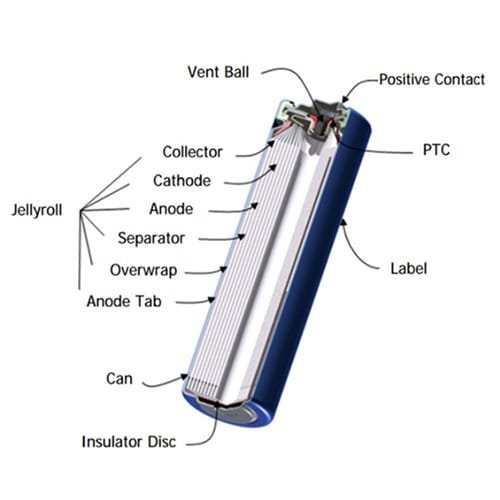
18650 Battery Structure
Simple Questions
The nominal voltage of a li ion lithium battery 18650 is typically 3.6–3.7 V, with a full charge around 4.2 V and a recommended cutoff voltage near 2.5–3.0 V depending on cell design and manufacturer.
INR 18650 batteries use a nickel-rich lithium-ion chemistry (NMC/NCA) that balances energy density and discharge capability, while IMR 18650 batteries use lithium manganese oxide (LMO) chemistry with lower capacity but higher thermal stability and safer high-drain performance.
A 18650 lithium ion battery has a standard cylindrical size of about 18 mm in diameter and 65 mm in length, with slight variations depending on whether the cell includes a protection circuit or button top.
A 18650 lithium ion battery will not fit in an AA battery case because it is much larger, measuring about 18 mm in diameter and 65 mm in length versus an AA battery’s roughly 14 mm by 50 mm size.
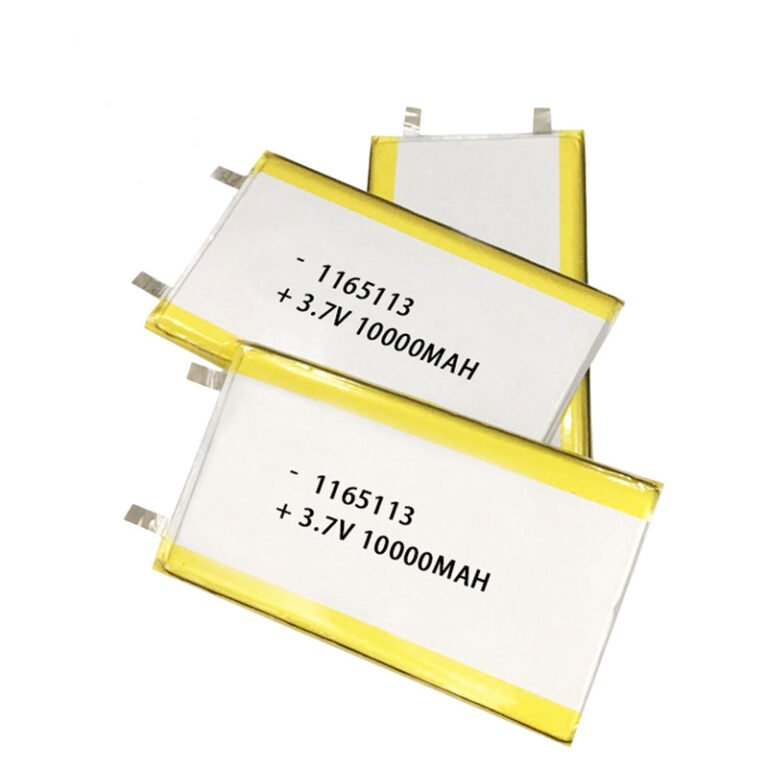
Lithium ion battery 18650 are lithium-ion (Li-ion) cells with a cylindrical metal can, not lithium-polymer (LiPo) batteries, which use pouch packaging and a different internal structure.
No, a genuine 18650 battery cannot reach 9900 mAh—real 18650 cells are physically limited to about 3500–3600 mAh, so higher claims indicate rewrapped or counterfeit batteries.
The main disadvantages of 18650 batteries are limited energy density compared with newer 21700 cells, sensitivity to overcharge and high temperatures, and the need for proper protection circuits to prevent safety risks.
Charging an 18650 lithium-ion battery typically takes 2–4 hours using a standard CC-CV charger, depending on the battery’s capacity, initial state of charge, and the charger’s current setting.
Yes, an 18650 lithium-ion battery can be over-discharged if its voltage drops below about 2.5 V, which permanently degrades capacity, increases internal resistance, and may cause safety issues if the cell is recharged without proper protection.
You can tell if an 18650 battery is protected by checking its length and construction, as protected cells are usually 2–5 mm longer due to the added protection circuit and wrapper.
Protected 18650 batteries often have a raised or button-top positive terminal and may list protection features on the label or datasheet.
18650 lithium ion batteries do not normally explode, but they can rupture or catch fire if overcharged, short-circuited, physically damaged, or used without proper protection circuitry and charging control.
Yes, 18650 LiFePO4 batteries exist, but they have a lower nominal voltage of about 3.2 V compared with standard 3.6–3.7 V lithium-ion 18650 cells and are used where higher cycle life and thermal stability are required. Explore 18650 LiFePO4 battery
A 48 V battery pack typically requires 13 series-connected 18650 lithium-ion cells (13S) because each 18650 has a nominal voltage of about 3.6~3.7 V, giving 46.8~48.1 V nominal depending on cell chemistry and design.
Understand 18650 Battery Chemistry & Capacity
What is the difference between INR, IMR, ICR and IFR?
INR, IMR, ICR, and IFR refer to different lithium battery chemistries that determine performance and safety characteristics. ICR (lithium cobalt oxide) prioritizes energy density, IMR (lithium manganese oxide) supports high discharge currents, INR (nickel-manganese-cobalt) balances capacity and power, while IFR (lithium iron phosphate) offers lower voltage but higher thermal stability and longer cycle life. These differences directly affect nominal voltage, discharge rating, lifespan, and appropriate application.
What is the mAh of a 18650 battery?
The mAh of a battery rechargeable 18650 typically ranges from about 1500 mAh to 3500 mAh, depending on the cell’s internal design and intended discharge rate. Higher-capacity 18650 cells are optimized for energy density, while lower-mAh versions usually support higher continuous discharge currents. The actual usable capacity is affected by load current, cutoff voltage, and operating temperature.
Can you mix 18650 batteries with different mAh?
You should not mix li ion 18650 batteries with different mAh ratings in the same pack or device, because capacity imbalance causes uneven charging and discharging.
Cells with lower capacity will reach full charge or deep discharge earlier, increasing the risk of overheating, accelerated aging, or protection circuit cutoff.
For safe and stable performance, use li ion 18650 batteries at same batch with the same capacity, chemistry, and state of health.
Internal Resistance
What does IR mean in batteries?
In batteries, IR (internal resistance) refers to the opposition to current flow inside the cell caused by electrode materials, electrolyte, and internal connections.
Lower battery IR means less voltage drop, reduced heat generation, and better efficiency, especially under high current loads.
As a battery ages or degrades, its internal resistance typically increases, leading to reduced performance and shorter usable runtime.
What is a good internal resistance for an 18650 battery?
A good internal resistance for an 18650 lithium-ion battery is typically below 30 milliohms (mΩ) when new, with high-quality cells often measuring 15–25 mΩ under standard test conditions.
Lower internal resistance indicates better power delivery, less heat generation, and higher efficiency, especially in high-drain applications.
Values above 50 mΩ usually indicate aging, damage, or a low-grade cell and can reduce performance and cycle life.
How to check internal resistance of 18650 battery?
To check the internal resistance of an 18650 battery, use a battery internal resistance tester or an AC milliohm meter, which provides the most accurate results without fully discharging the cell.
Alternatively, measure voltage drop under a known load and calculate resistance using R = ΔV / I, ensuring the battery is at rest and near room temperature.
For reliable comparison, test at a similar state of charge each time, as internal resistance varies with temperature, charge level, and aging.
18650 C Rate
What is C in an 18650 battery?
For most standard 18650 lithium-ion cells, the typical continuous discharge rate ranges from about 0.5C to 1C, while high-drain models can support 10C or more.
The exact C-rate depends on the specific cell chemistry, design, and manufacturer specifications.
What is the best charge rate for 18650 battery?
The best charge rate for an 18650 lithium-ion battery is typically 0.5C (for example, 1.25 A for a 2500 mAh cell), which balances charging speed, safety, and cycle life.
Most manufacturers allow charging up to 1C under controlled conditions, but higher rates increase heat and long-term degradation.
How does the C rate impact capacity?
The C rate affects measured battery capacity because higher discharge rates reduce the time available for electrochemical reactions inside the cell.
At high C rates, increased internal resistance causes voltage drop and heat, making the battery reach its cutoff voltage sooner and deliver less usable capacity.
Lower C rates allow more complete energy extraction and typically result in higher apparent capacity and better efficiency.
Protected VS Unprotected
What are the two types of 18650 batteries?
The two main types of 18650 lithium-ion batteries are protected and unprotected cells.
Protected 18650 batteries include a built-in protection circuit to prevent overcharge, over-discharge, and short circuits, while unprotected cells rely on the device or battery management system for safety.
The choice depends on the application’s safety design, current demand, and whether external protection is already provided.
Charge and Discharge
An 18650 lithium-ion battery is typically charged using a constant-current/constant-voltage (CC/CV) method up to about 4.2 V per cell.
During discharge, the voltage gradually drops from around 4.2 V to a safe cutoff near 2.5–3.0 V, depending on cell design.
Staying within recommended charge and discharge limits is critical to maintain capacity, cycle life, and safety.
What is the 80/20 rule for charging?
The 80/20 rule for charging refers to keeping a battery’s state of charge between about 20% and 80% to reduce stress on the electrodes.
Avoiding frequent full charges and deep discharges helps slow chemical degradation and extends overall cycle life, especially for lithium-ion batteries.
This practice is most effective for daily use devices where maximum runtime is less critical than long-term battery health.
What is 80% DOD in battery?
80% DOD (Depth of Discharge) means that 80% of a battery’s total rated capacity has been used, leaving 20% remaining.
For example, an 80% DOD on a 100 Ah battery means 80 Ah has been discharged before recharging.
Operating at or below 80% DOD is commonly recommended to extend cycle life, especially for lithium and lead-acid batteries.
Cycle Life
How long will 18650 battery last?
How long an 18650 lithium battery lasts depends on its capacity, discharge current, and usage pattern rather than size alone. In typical applications, a 2500–3500 mAh 18650 cell can power low-drain devices for many hours, while high-drain loads may reduce runtime to less than an hour. Overall service life is usually 300–800 full charge cycles, depending on cell chemistry, depth of discharge, and operating temperature.
How to check 18650 battery health?
You can check 18650 battery health by measuring its actual capacity through a controlled charge–discharge test and comparing it to the rated mAh in the manufacturer’s datasheet.
Monitoring internal resistance (IR) and voltage sag under load also helps identify aging, as higher IR indicates reduced efficiency and power capability.
For consistent results, test at room temperature and the same state of charge, since heat, load current, and test method affect readings.
18650 Battery Applications
What are the applications of 18650 batteries?
18650 batteries are widely used in devices that require a balance of energy density, durability, and standardized size. Common applications include laptops, power tools, flashlights, medical equipment, electric bikes, and battery packs for energy storage systems. Their consistent dimensions and electrical characteristics make them suitable for both consumer electronics and industrial battery assemblies.
What household items use 18650 batteries?
lithium ion batteries 18650 are commonly used in household items such as high-power flashlights, cordless vacuum cleaners, and portable fans.
They are also found in power banks, emergency lighting, and some rechargeable household tools that require high current output.
Devices using 18650 cells typically include built-in battery packs rather than user-replaceable batteries for safety and reliability.
Battery Safety
How to safely store 18650 cells?
To safely store 18650 cells, keep them in a cool, dry environment away from direct sunlight and flammable materials. Store lithium-ion 18650 batteries at a partial charge level, typically around 30–50%, to reduce aging and internal stress during long-term storage. Always use non-conductive cases or terminal covers to prevent short circuits, especially when storing loose cells.
Can you revive a dead 18650?
A “dead” 18650 battery can sometimes be temporarily revived only if it is over-discharged but not physically damaged or internally shorted.
If the cell voltage has dropped below about 2.0 V, specialized chargers may slowly restore voltage, but capacity and safety are usually degraded.
Do not attempt revival if the 18650 is swollen, leaking, overheated, or reads 0 V, as replacement is the only safe option.
How to dispose of 18650 batteries?
18650 batteries should be disposed of through designated lithium-ion battery recycling programs rather than thrown in household trash. Most electronics retailers, recycling centers, and municipal waste facilities accept used 18650 cells to recover metals and prevent fire hazards. Before disposal, tape or cover the terminals to reduce the risk of short circuits during handling and transport.
18650 Battery Buying Guide
What is a good 18650 battery?
A good 18650 rechargeable battery is one that matches the application’s requirements for capacity, discharge current, and safety rather than simply having the highest mAh rating. Quality cells come from established manufacturers and provide verified datasheets, consistent performance, built-in safety vents, and stable cycle life. For practical selection, prioritize authentic cells with a suitable continuous discharge rating and proven reliability in real operating conditions.
What is the best 18650 battery brand?
For 18650 li ion battery, the “best” brand is one that provides authentic cells with published datasheets and consistent performance rather than unknown sellers. Widely recognized OEM brands with reliable quality control include Panasonic/Sanyo, Samsung SDI, LG Chem, Sony/Murata, and Molicel across a range of capacities and discharge ratings. Choosing a brand with traceable specifications and tested performance reduces safety risks and ensures expected runtime in your application.
Where can i buy 18650 batteries?
You can buy li ion lithium battery 18650 from specialized battery distributors, electronics component suppliers, and reputable online marketplaces that provide full technical specifications and traceable brands. For industrial or bulk use, manufacturers and authorized wholesalers are preferred to ensure consistent quality, authentic cells, and compliance with transport regulations.
Consider to buy 18650 batteries in bulk? request datasheet.