
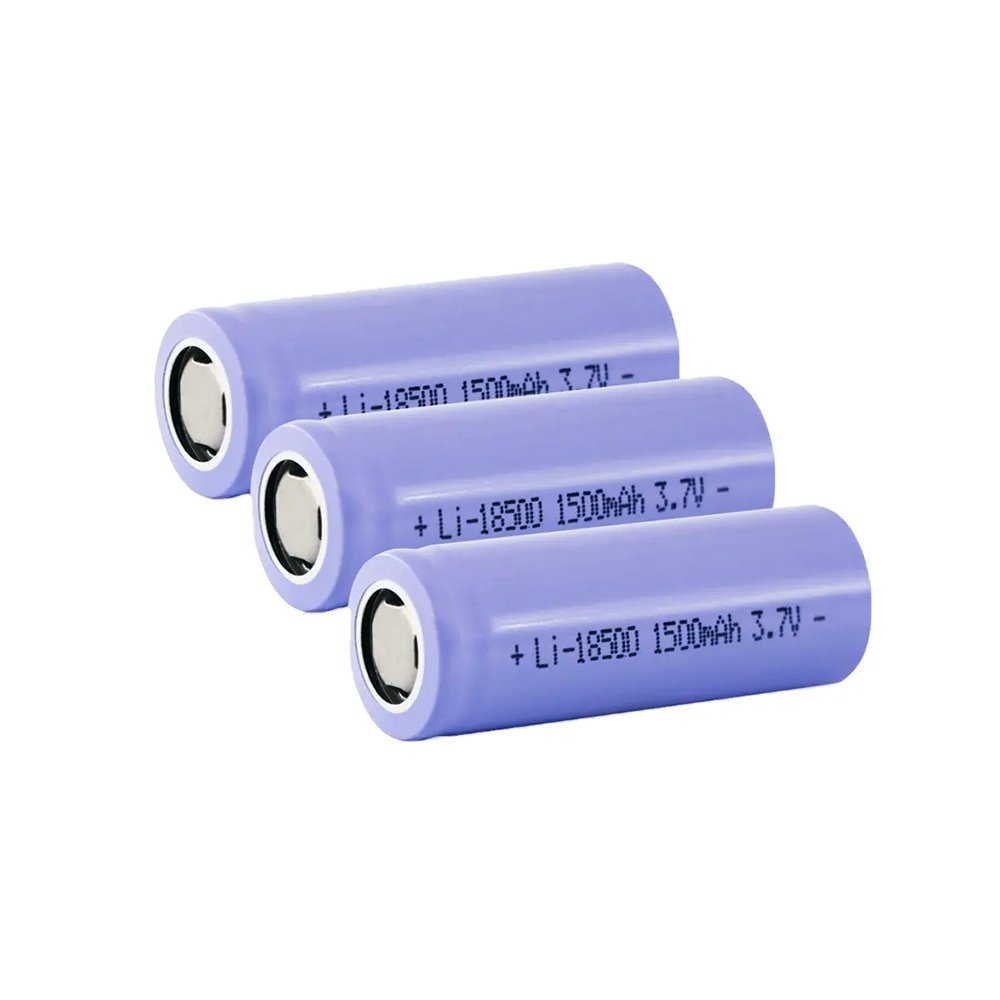
3.7V 18500 1500mAh 1C Battery Lithium Ion Cell
Summary of 18500 1500mAh 1C Lithium Ion Battery 3.7V
The 3.7V 18500 1500mAh 1C Lithium-Ion Battery Cell is a compact, high-performance power solution engineered for devices with strict size constraints and high energy demands. With an energy density up to 185Wh/kg, advanced safety protection (CID pressure relief valve), and a wide operating temperature range (-20°C to 65°C), this 18500 cell delivers longer runtime, higher reliability, and flexible customization, making it ideal for professional and industrial applications.
The 18500 battery cell bridges the gap between 14500 and 18650 formats. Compared with standard 18650 cells, it features a shorter height, enabling better integration into compact or special-dimension devices without compromising capacity or safety.
18500 Li Ion Battery 1500mAh Specification
Model: 18500
Rated capacity: 1500mAh
Energy: 5.55Wh
Energy Density: 185Wh/kg
Minimal Capacity: 1450mAh
Rated voltage: 3.7V
Discharge Cut-off Voltage: 2.75V
Charge Cut-off Voltage: 4.2V
Cycle Life: More than 500 cycles
Dimensions: Φ18*50mm
Weight: 30g
Internal Resistance: Less than 50mΩ
Standard Discharge Current: 0.2C (300mA)
Standard Charge Current: 0.2C (300mA)
Max Continuous Discharge Rate: 1C (1.5A)
Max Continuous Charge Current: 1C (1.5A)
Charging Temperature: 0 to 45℃;
Discharge Temperature: -20 to 65℃
Storage Temperature:
- -20℃~25℃: 12 months
- -20℃~45℃: 3 months
- -20℃~60 ℃: 1 month
Key Features – 18500 Lithium Ion Battery
⚡ High Energy Density – Up to 185Wh/kg
Advanced lithium-ion chemistry ensures more power in less space, supporting longer device runtime while keeping weight low.
🔋 High Capacity – 1500mAh for Extended Runtime
The 1500mAh capacity significantly improves endurance, reducing charging frequency and enhancing user experience.
📏 Compact Size – Smaller Height Than 18650
The reduced height makes this 18500 battery ideal for custom housings, slim designs, and space-limited equipment where 18650 cells cannot fit.
🛡️ Enhanced Safety with Built-in CID Pressure Relief Valve
Each cell includes a Current Interrupt Device (CID). In abnormal conditions such as short circuit, overcharge, or internal pressure buildup, the valve activates to cut off current and release pressure, preventing fire, swelling, or explosion.
🔥 Wide Operating Temperature Range
Reliable performance from -20°C to 65°C, ensuring stable discharge even in low-temperature or high-heat environments.
🧩 Fully Customizable Battery Solutions
We support custom voltage, capacity, discharge rate (C-rate), cycle life, and OEM branding, enabling seamless integration into your products.
❓ Frequently Asked Questions (FAQ)
Q1: What is the difference between 18650 and 18500 batteries?
The main difference between 18650 and 18500 batteries is their size: an 18650 cell is taller (65 mm) than an 18500 cell (50 mm), while both have the same 18 mm diameter. Because of the larger size, 18650 batteries usually offer higher capacity, whereas 18500 batteries are better suited for compact devices with height limitations.
Q2: What are 18500 batteries used for?
18500 batteries are commonly used in compact electronic devices that require reliable power but have limited internal space, such as medical equipment, industrial instruments, and custom battery packs. Their shorter height compared to 18650 cells makes them ideal for applications with special size constraints while still delivering stable lithium-ion performance.
Q3: How to break in a new Lithium-Ion battery?
Simply use it normally and charge it when needed—no special conditioning cycles are required. After a few regular charge and discharge cycles, the battery’s performance and capacity readings will naturally stabilize.
Q4: What is the best charging routine for a lithium-ion battery?
The best charging routine for a lithium-ion battery is to keep the charge level between 20% and 80% whenever possible and avoid deep discharges. Using a quality charger and unplugging the battery once it’s full helps reduce heat and extend overall battery lifespan.
Q5: How often should you charge a lithium battery when not in use?
Cylindrical Battery Cell List
Model Name |
Battery Type |
Nominal Voltage |
Nominal Capacity |
Diameter (±0.5mm) |
Length (±0.5mm) |
Weight (±5%) |
Max Charge Current |
Max Discharge Current |
Max Internal Resistance |
| 10840 | Li-ion | 3.7V | 600mAh | 10mm | 84mm | 17g | 0.6A | 1.8A | 65mΩ |
| 13300 | Li-ion | 3.7V | 400mAh | 13mm | 30mm | 10g | 0.4A | 0.4A | 75mΩ |
| 13430 | Li-ion | 3.7V | 750mAh | 13mm | 43mm | 15g | 375mA | 0.75A | 80mΩ |
| 14430 | Li-ion | 3.7V | 650mAh | 14mm | 43mm | 17g | 0.65A | 1.95A | 70mΩ |
| 14500 | Li-ion | 3.7V | 500mAh | 14mm | 50mm | 18g | 1A | 1A | 60mΩ |
| 14500 | Li-ion | 3.7V | 600mAh | 14mm | 50mm | 18g | 1.2A | 1.2A | 60mΩ |
| 14500 | Li-ion | 3.7V | 650mAh | 14mm | 50mm | 19.5g | 0.65A | 9.75A | 30mΩ |
| 14500 | Li-ion | 3.7V | 800mAh | 14mm | 50mm | 20g | 0.8A | 2.4A | 70mΩ |
| 14650 | Li-ion | 3.7V | 900mAh | 14mm | 65mm | 26g | 0.9A | 13.5A | 30mΩ |
| 14650 | Li-ion | 3.7V | 1200mAh | 14mm | 65mm | 25g | 1.2A | 3.6A | 55mΩ |
| 16340 | Li-ion | 3.7V | 600mAh | 16mm | 34mm | 16.5g | 0.6A | 9A | 48mΩ |
| 16340 | Li-ion | 3.7V | 700mAh | 16mm | 34mm | 17g | 0.7A | 2.1A | 75mΩ |
| 16500 | Li-ion | 3.7V | 800mAh | 16mm | 50mm | 24.5g | 0.8A | 8A | 25mΩ |
| 16500 | Li-ion | 3.7V | 1200mAh | 16mm | 50mm | 27.5g | 1.2A | 3.6A | 55mΩ |
| 16650 | Li-ion | 3.7V | 2000mAh | 16mm | 65mm | 36g | 2A | 6A | 60mΩ |
| 18350 | Li-ion | 3.7V | 850mAh | 18mm | 35mm | 21.5g | 0.85A | 4.25A | 70mΩ |
| 18350 | Li-ion | 3.7V | 1100mAh | 18mm | 35mm | 27g | 1.1A | 3.3A | 60mΩ |
| 18500 | Li-ion | 3.7V | 1000mAh | 18mm | 50mm | 28g | 1A | 2A | 60mΩ |
| 18500 | Li-ion | 3.7V | 1200mAh | 18mm | 50mm | 29g | 1.2A | 2.4A | 60mΩ |
| 18500 | Li-ion | 3.7V | 1400mAh | 18mm | 50mm | 30g | 1.4A | 2.8A | 50mΩ |
| 18500 | Li-ion | 3.7V | 1500mAh | 18mm | 50mm | 30g | 1.5A | 1.5A | 50mΩ |
| 18500 | Li-ion | 3.7V | 1900mAh | 18mm | 50mm | 35.2g | 1A | 1A | 55mΩ |
| 22430 | Li-ion | 3.7V | 2000mAh | 22mm | 43mm | 43g | 2A | 6A | 75mΩ |
| 22500 | Li-ion | 3.7V | 2400mAh | 22mm | 50mm | 46g | 2.4A | 7.2A | 60mΩ |
| 22650 | Li-ion | 3.7V | 3000mAh | 22mm | 65mm | 63.5g | 3A | 9A | 55mΩ |
| 22650 | Li-ion | 3.7V | 4000mAh | 22mm | 65mm | 65.3g | 2A | 4A | 40mΩ |
| 18500 | LiFePO4 | 3.2V | 800mAh | 18mm | 50mm | 23.5g | 0.4A | 0.8A | 60mΩ |
| 18500 | LiFePO4 | 3.2V | 1000mAh | 18mm | 50mm | 27.5g | 0.5A | 1A | 40mΩ |
| 18500 | LiFePO4 | 3.2V | 1200mAh | 18mm | 50mm | 30.5g | 0.6A | 1.2A | 40mΩ |
Related Battery
18350 1100mAh 3C Lithium Ion Cell
16500 1200mAh 3C Li Ion Battery