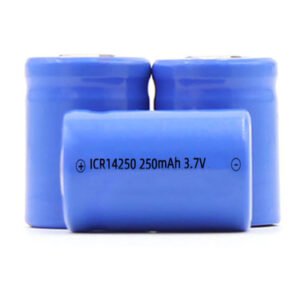


3.2V 14430 400mAh 1C LiFePo4 Battery Cell
Summary of 14430 400mAh 1C Lithium Lifepo4 Battery
The 400 mAh 3.2V LiFePo4 14430 battery cell is engineered for applications where dimensional constraints, safety margin, and long service life are more critical than peak energy density. With a short height and small diameter, this cylindrical cell integrates easily into tightly packed devices while maintaining excellent thermal tolerance, low self-discharge, and a cycle life exceeding 4000 cycles with ≥80% remaining capacity.
14430 Lifepo4 3.2 V Battery Specification
Model: 14430 3.2 -Volt Rechargeable
Rated capacity: 400mAh
Energy: 1.28Wh
Energy Density: 98.46Wh/kg
Minimum Capacity: 390mAh
Rated voltage: 3.2V
Discharge Cut-off Voltage: 2.5V
Charge Cut-off Voltage: 3.65V
Cycle Life: More than 4000 cycles
Dimensions: Φ14*43mm
Weight: 13g
Internal Resistance: Less than 60mΩ
Standard Discharge Current: 0.2C (80mA)
Standard Charge Current: 0.2C (80mA)
Max Continuous Discharge Rate: 1C (400mA)
Max Continuous Charge Current: 0.5C (200mA)
Charging Temperature: 0 to 45℃;
Discharge Temperature: -20 to 60℃
Storage Temperature:
- -20℃~25℃: 12 months
- -20℃~45℃: 3 months
- -20℃~60 ℃: 1 month
Key Features – 14430 Rechargeable Battery
🛡️ Safety Characteristics (Core Advantage)
LiFePO4 chemistry is inherently more stable than ternary lithium-ion systems (NCM/NCA). From an engineering perspective, this means higher thermal runaway threshold, slower exothermic reaction rate under abuse conditions, stronger crystal structure during repeated cycling. In practical use, this significantly reduces risks related to overheating, internal short circuits, and mechanical stress.
📐 Compact Size for Space-Constrained Designs
The 14430 cell is particularly suitable for devices with limited space, narrow enclosures requiring small radial clearance or multi-cell parallel layouts where thermal spacing is limited. Its geometry simplifies battery pack stacking and reduces enclosure redesign cost.
🌡️ Wide Operating Temperature Range
This cell maintains stable electrochemical behavior across a wide temperature window, especially at elevated temperatures where conventional Li-ion cells degrade rapidly. Suitable for industrial electronics, reliable in outdoor or sealed environments, reduce risk of capacity collapse under heat exposure. From a factory testing standpoint, LiFePO4 cells consistently show lower impedance growth at high temperatures.
🔄 Cycle Life Performance
Under standard charge/discharge conditions (0.2C rate, controlled temperature), cycle life reaches 4000 cycles, remaining capacity stays above 80% of initial value. This makes the cell appropriate for applications where replacement is costly or impractical, such as embedded systems or permanently installed equipment.
⚡ Low Self-Discharge Behavior
LiFePO4 chemistry exhibits strong calendar stability, monthly self-discharge rate less than 1%, suitable for backup power and standby systems, reduced need for maintenance charging. This characteristic is especially valuable for devices stored or used intermittently.
❗ Often Overlooked Points & Common Misconceptions
⚠️ What Engineers and Buyers Frequently Miss
-
LiFePO4 ≠ High Energy Density
This cell prioritizes safety and longevity, not maximum Wh/kg. -
1C Rating Is a Design Boundary, Not a Suggestion
Exceeding it may not cause immediate failure but will shorten cycle life. -
Wide Temperature Range ≠ Unlimited High-Temp Charging
High-temperature discharge is more tolerant than high-temperature charging. -
Small Cells Are More Sensitive to Assembly Quality
Welding method, pressure control, and insulation directly affect lifespan.
14mm Diameter Cylindrical LiFePO4 Battery Cell
Model Name |
Battery Type |
Nominal Voltage |
Nominal Capacity |
Diameter (±0.5mm) |
Length (±0.5mm) |
Weight (±5%) |
Max Charge Current |
Max Discharge Current |
Max Internal Resistance |
| 14250 | LiFePO4 | 3.2V | 180mAh | 14mm | 25mm | 12g | 90mA | 0.18A | 80mΩ |
| 14430 | LiFePO4 | 3.2V | 400mAh | 14mm | 43mm | 13g | 0.2A | 0.4A | 60mΩ |
| 14430 | LiFePO4 | 3.2V | 500mAh | 14mm | 43mm | 15g | 0.25A | 0.5A | 60mΩ |
| 14500 | LiFePO4 | 3.2V | 500mAh | 14mm | 50mm | 16.5g | 0.25A | 0.5A | 60mΩ |
| 14500 | LiFePO4 | 3.2V | 600mAh | 14mm | 50mm | 18g | 0.3A | 0.6A | 60mΩ |
| 14650 | LiFePO4 | 3.2V | 800mAh | 14mm | 65mm | 22g | 0.4A | 0.8A | 60mΩ |
| 14650 | LiFePO4 | 3.2V | 1000mAh | 14mm | 65mm | 23.5g | 0.5A | 1A | 60mΩ |
📞 Call to Action – Engineering-Level Support
Our engineering team supports cell selection, validation, and pack design based on real operating conditions—not assumptions. Contact us to discuss your application constraints and reliability requirements.
❓ FAQ – Frequently Asked Questions
Q1: What is a 14430 battery?
Q2: What applications is the 14430 LiFePO4 cell best suited for?
A: It is commonly used in compact industrial devices, backup power modules, medical electronics, sensors, and space-limited embedded systems.
Q3: Is this cell safer than standard 3.7V lithium-ion cells?
A: Yes. LiFePO4 chemistry has higher thermal stability and lower risk of thermal runaway under abuse conditions.
Q4: Can it really reach 4000 cycles in real use?
A: Under controlled charge/discharge rates and appropriate temperature management, this cycle life is achievable based on industry-standard testing.
Q5: Is a protection circuit still required?
A: Yes. While LiFePO4 is safer, proper BMS or protection circuitry is still required for overcharge, over-discharge, and short-circuit protection.
Related Battery
3.2V LiFePO4 18650 2000mAh 1C Battery Cell
3.2V 26650 4000mAh 5C Battery Cell